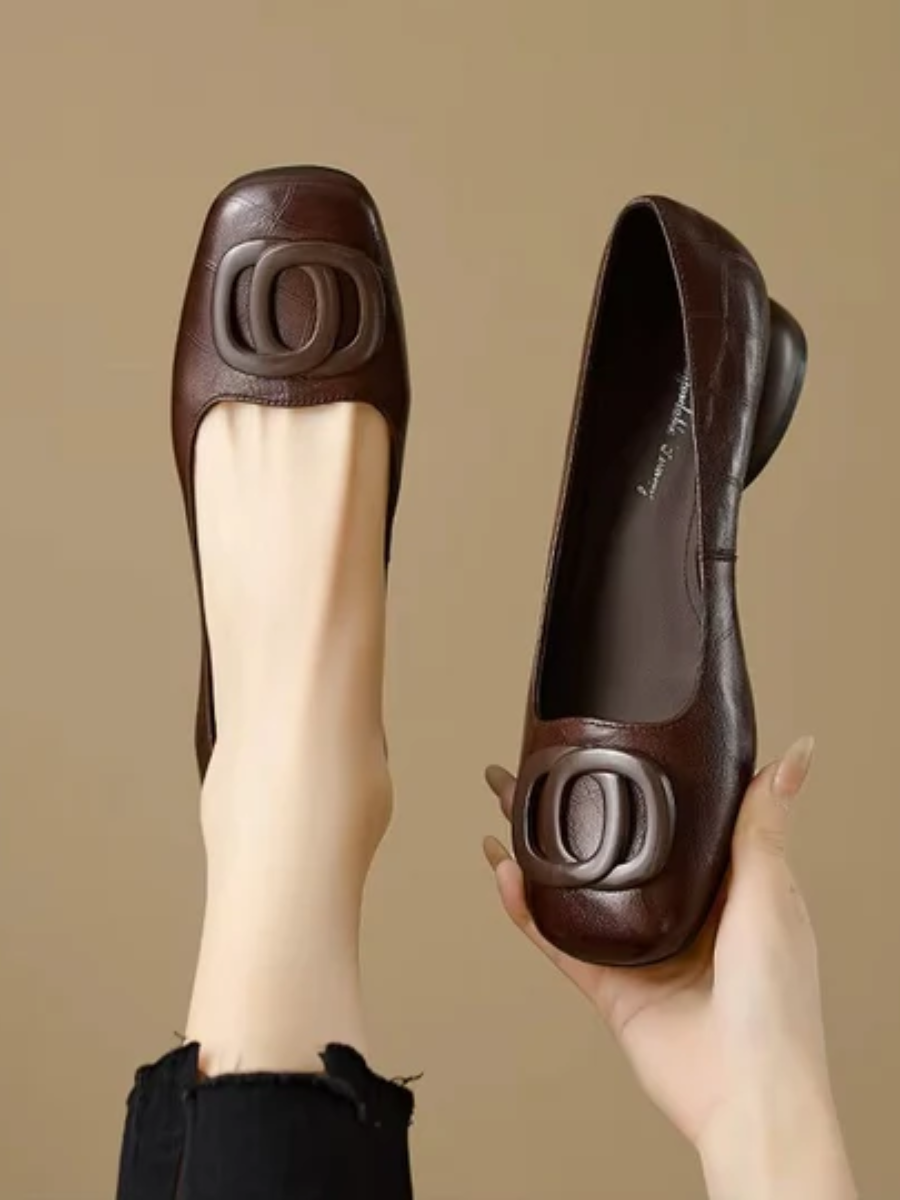
The Opium Leather Flats · An editorial
Most women assume the afternoon ache is something happening to their feet. In a lot of cases it is something happening to their shoes — and you can check it yourself in about thirty seconds.
Ask a woman in her sixties how her feet are and you will usually get some version of the same answer. Fine in the morning. Done by the afternoon.
And then, almost always, an explanation offered up before anyone asks for one: well, I’m not twenty-five anymore.
Here is the thing about that explanation. It is the wrong shape. Ageing is gradual and constant. It does not have a start time. And yet almost every woman who describes this can tell you roughly when it kicks in — somewhere between two and four, on a day when she has been up and about.
Something that happens at a specific hour isn’t a condition. It’s an accumulation.
An ordinary day of errands is somewhere in the range of five to seven thousand steps. Now think about what one step costs you in the wrong shoe.
If the sole is stiff, your foot has to bend the shoe before it can finish the step. That is a small amount of extra effort — genuinely small, far too small to notice once. But you are not doing it once. You are doing it six thousand times before dinner.
If the toe box narrows where your foot is widest, your toes are held slightly compressed the entire time. Not painfully. Just braced. Muscles that ought to be idle are quietly working all day, and they do not clock off until the shoes come off.
If there is no real cushioning under the ball and the heel, every one of those six thousand steps sends its full load into two small areas of your foot with a thin lining and a hard base in between.
None of that hurts at eleven o’clock. All of it is arriving by three.
Because the shoes felt fine.
That is the trap. You tried them on, walked to the front of the shop and back, and they were comfortable — because at twenty steps every one of these problems is invisible. Stiffness does not matter at twenty steps. Compression does not matter at twenty steps. A hard base under a thin lining feels absolutely fine at twenty steps.
Comfort at twenty steps and comfort at six thousand are two different properties, and a fitting room can only ever show you the first one.
No expertise required, and you do not need to buy anything to do it. Take the shoe off. Tick each one your current pair fails.
01
Hold the shoe at heel and toe and fold it. Does it flex easily where the ball of your foot sits, or does it resist?
A stiff sole means your foot has to overcome the shoe on every single step. Many are sold with the promise that they soften eventually — which means the breaking-in is being charged to you, a fortnight at a time.
The sole flexes where your foot flexes, from the first wear. There is nothing to break in, so the shoe never asks your foot to do the work of persuading it.
02
From above, follow the outline from the heel forward. Find the point where the shoe stops getting wider and starts closing in. Now find the widest part of your actual foot — across the ball, roughly where the shoe creases when you walk.
A tapered or pointed toe begins closing in before it reaches the ball of the foot, because a point is cheaper to pattern and photographs longer. Your toes are drawn in toward each other and held there all day.
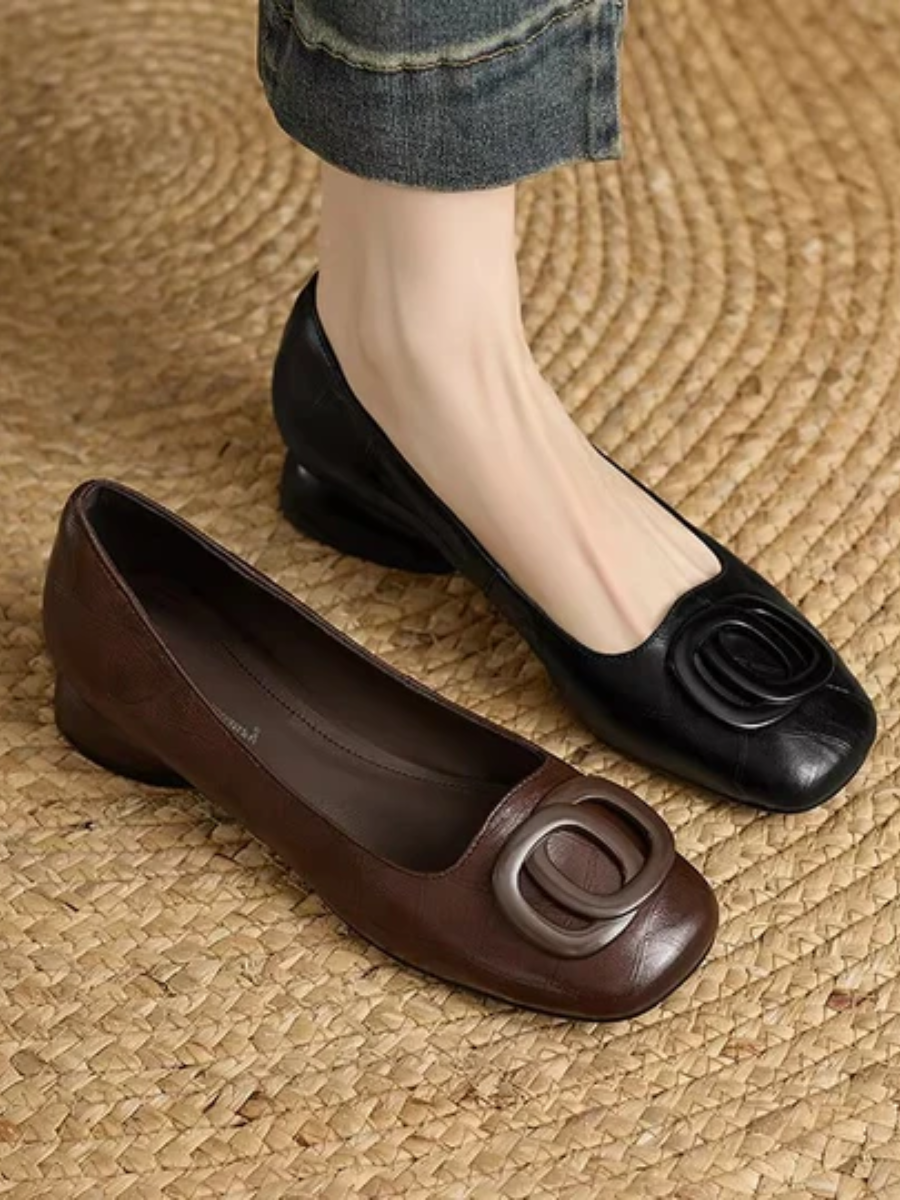
A structured square toe holds its width all the way forward. Your toes lie flat. And because the leading edge is a straight, deliberate line, it reads as a design decision rather than as a wide shoe — which is the whole reason the square toe works where a rounded one does not.
03
Push your thumb hard into the insole, under where the ball of your foot sits, and then under the heel. Is there anything there that gives?
A thin lining over a hard base is the single most common shortcut in this category, precisely because it is invisible in a photograph. You find out about it on pavement, not in the first ten minutes.
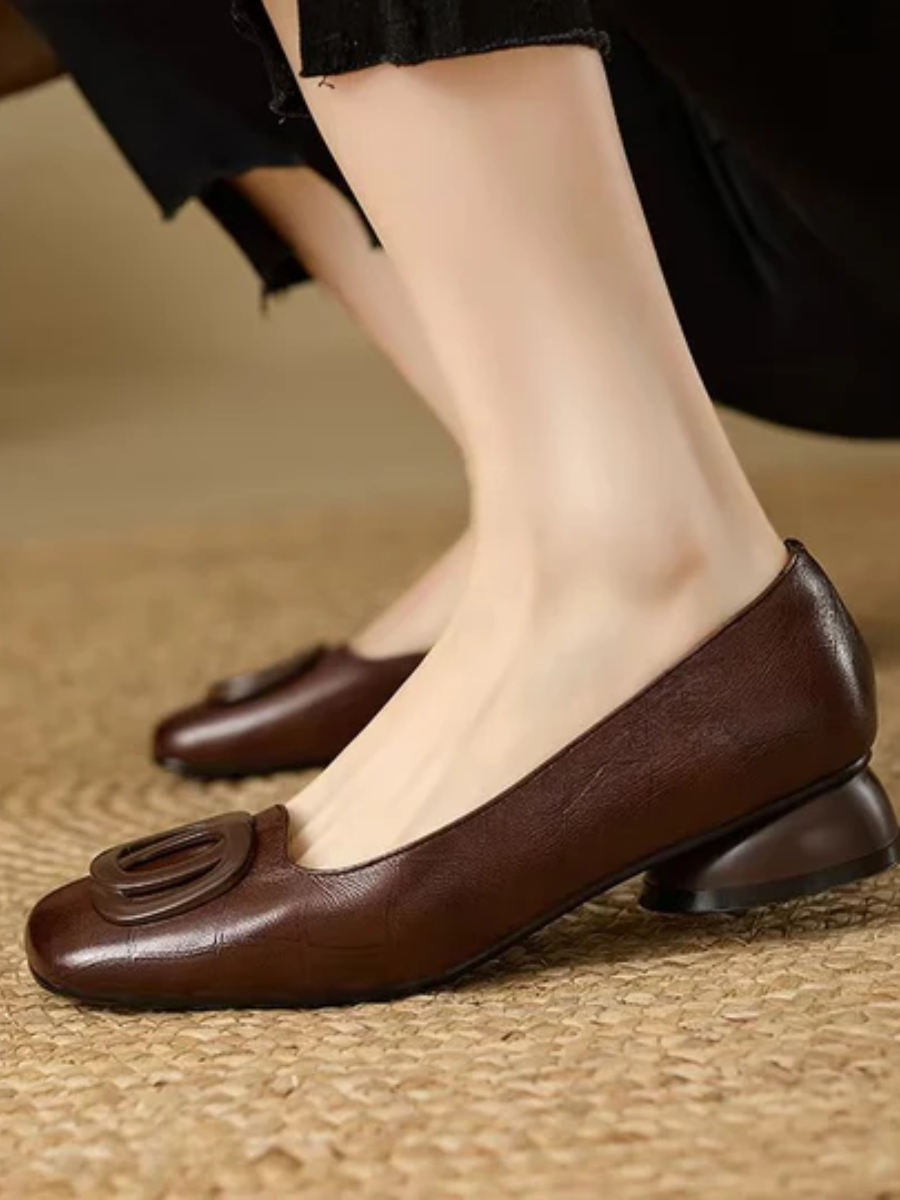
A cushioned footbed under the ball and the heel — the two places that actually take the load, and the two places the ache starts somewhere in the fourth hour.
04
Find where the listing or the label says what the upper is made of. Read it exactly.
A fabric backing with a plastic coating embossed to look like grain. It photographs beautifully, which is most of the point. But a coating on a backing has one predictable failure: repeated flexing separates the two, and it separates first exactly where your foot bends most. If a listing could say leather with nothing attached, it would.
The upper is genuine leather. Not faux, not coated. It moulds to your foot over the first few weeks, so the fit gets better with wear rather than staying exactly as wrong as it was on day one.
Your result
Tick the boxes above as you go and your result will appear here.
| Most flats under $100 | The Opium | |
|---|---|---|
| Upper | Coated synthetic, cracks at the flex point | Genuine leather, moulds to the foot |
| Toe | Narrows at the widest part of the foot | Structured square, width held forward |
| Sole | Stiff, needs breaking in | Flexible from the first day |
| Underfoot | Thin lining over a hard base | Cushioned footbed, ball and heel |
Not much, dramatically. That is rather the point.
You get to three o’clock and you have not thought about your feet. Then four. Then you are out at seven and it has not come up. And a few days later you notice you have stopped planning your day around how long you will be standing.
Before you buy anything at all — ours or anyone else’s — do the four tests on the shoes you have on. It costs nothing, it takes half a minute, and it will tell you more than any product description will.
— Nell, Nora & Nina