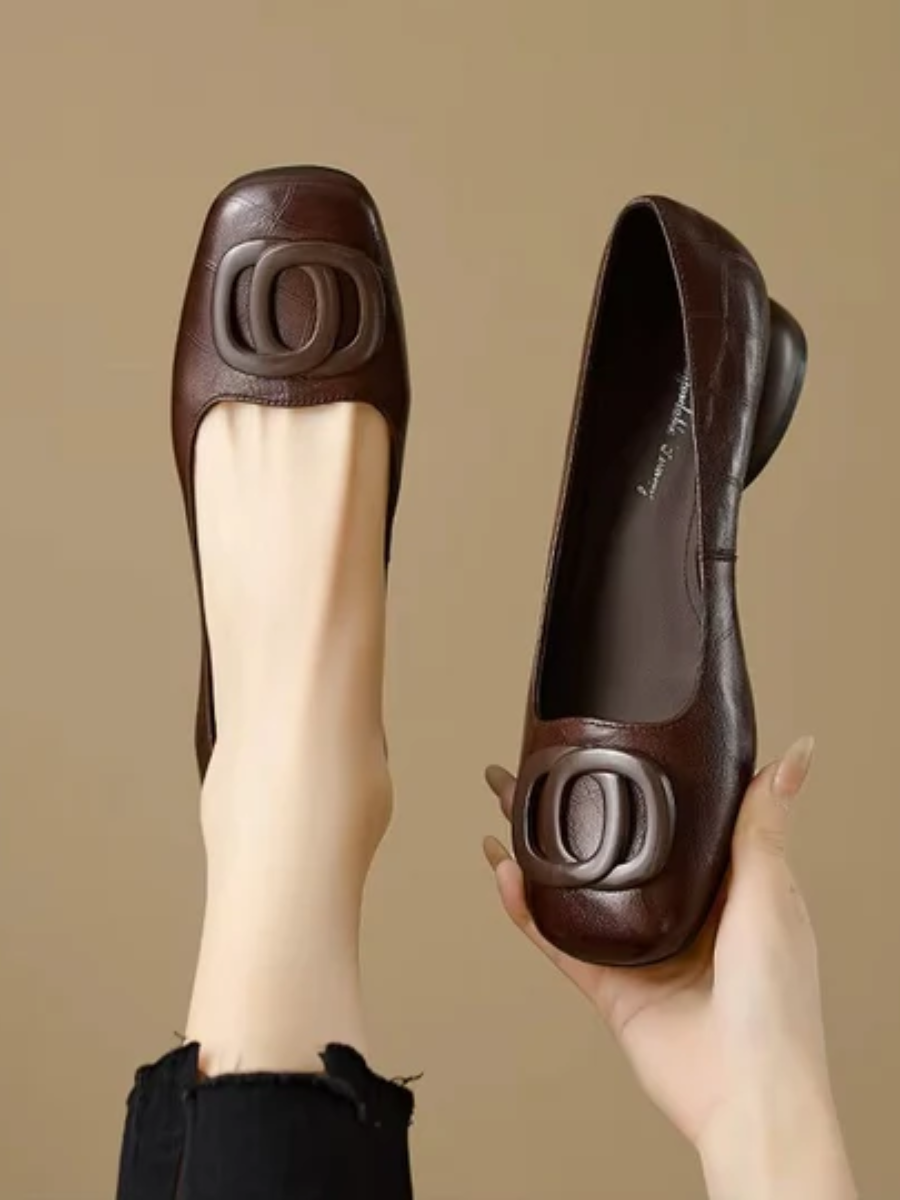
The Opium Leather Flats · An editorial
A drawer full of shoes you don’t wear isn’t bad luck or bad judgement. It is four specific manufacturing decisions, and you can learn to catch all four.
Open the drawer. Not the ones you wear — the other ones. The ones that seemed right.
For most women there are four or five pairs in there, and each one represents a genuine, careful decision. She looked at them. She thought about it. She bought them for a reason.
And they are in the drawer.
The story we tend to tell about that drawer is a story about ourselves: I’m hopeless at buying shoes. I always get talked into things. I should have known.
That story is wrong, and it’s expensive — because it means you go into the next purchase trusting your instincts less and the marketing more.
Here is the better story. Flats fail in four specific ways. You have probably met all four. And once you can name them, you can check for them in about ninety seconds, including online.
01
The classic. Lovely upper, elegant line, and a sole roughly the thickness of a beer mat.
It is comfortable in the shop because twenty steps on carpet is not a test of anything. It is comfortable for the first hour. Then you are on pavement, and every step arrives in your heel with nothing in between.
You blamed your heels. It was the footbed.
Press your thumb hard into the insole under the ball of the foot and under the heel. If nothing gives, you have found failure one. In a listing, look for the words cushioned footbed — and if the listing does not mention the footbed at all, assume there is not one worth mentioning.
02
You bought them knowing they were a little snug, because everyone says leather gives. Sometimes it does. But a shoe that is too narrow at the toe is not too small — it is the wrong shape, and shape does not stretch its way into being right.
Your foot is widest across the ball. A tapered toe box starts narrowing before it gets there. So the widest part of your foot is being squeezed by the part of the shoe that is already closing.
You blamed your bunion, or your wide feet. It was the pattern.
Look straight down at the shoe from above. Does the width hold to the front, or does it start closing in early? A squared front edge holds width where you need it. A pointed or almond front takes it away exactly there.
03
They were stiff. You were told they would soften. You wore them twice, both times unpleasant, and then a day came when you needed to be comfortable and you reached past them.
They are still stiff. They will be stiff forever, because you never got to the mileage.
You blamed yourself for not persevering. But a shoe that needs a fortnight of suffering before it behaves is a shoe with a design problem, and the fortnight is being charged to you.
Hold the shoe at heel and toe and fold it. If it fights you, your foot will be fighting it too — on every step, for as long as you own them.
04
This one is harder to admit, so it usually gets described as they just weren’t me.
They were comfortable. Properly comfortable. And every time you put them on you looked in the mirror and saw someone who had stopped trying, so they went in the drawer alongside the ones that hurt.
That is not vanity. Feeling like yourself is a real requirement, and any shoe that fails it has failed — no matter how good the footbed is.
Ask whether you would wear them if your feet were perfect. If the answer is no, comfort will not save them.
Your drawer
Tick the ones you recognise and your result will appear here.
The four failures do not overlap much, which is why almost every flat fixes one or two and quietly loses on the others. The pretty one loses on cushioning. The comfort one loses on failure four. The designer one loses on toe shape, because price buys materials, not width.
That is the actual reason your drawer looks like it does. Not judgement. Coverage.
We would rather you used the checklist than took our word, so here it is, straight.
| Failure | What causes it | The Opium |
|---|---|---|
| One | Thin lining over a hard base | Cushioned footbed, ball and heel |
| Two | Toe narrows at the widest point | Structured square toe, width held forward |
| Three | Stiff sole, long break-in | Flexible from day one, nothing to break in |
| Four | Looks orthopaedic | Leather, clean square line, one detail |
Use the checklist on us. Then use it on everything else you are looking at. It works either way, and honestly, we would rather you never bought another pair you do not wear — including ours.
Run the four tests. If we fail one, don’t buy them.
— Nell, Nora & Nina